The loss of a loved one is a stark reminder of how short
life really is, especially when they go before their time. Last week, Tony Sly
was taken too soon, dying peacefully in his sleep at age 41. He is survived by
his wife Brigitte, their two daughters Fiona and Keira, his brothers Mike and
Jonathan Sly, and his parents Pauline and John Sly. In our time of grief it has
been the stories from all over the world shared by band members, friends, and
fans that have brought solace in an inconsolable time. To his family, he was a
loving husband, a father, a brother, and a son; to us he was a loyal friend, an
artist, a poet, and a philosopher. He was a man unafraid to bare his soul to
the world. Throughout his lifetime as a musician, whether it was fronting No
Use For a Name, or during his solo career, it was as if he was speaking
directly to each of us, and because of that, each of us felt a special
connection to him. Of course the real connection was to his family, and his
loved ones, but somehow when he sang “International You Day” (for Brigitte of
course) you felt that he was singing to you. Thank you, Brigitte, Fiona, and
Keira, for sharing him with us. He was loved by so many, and will be forever
missed.
With a heavy heart we will say goodbye to Tony this Friday,
August 10th in San Jose at Cathedral Basilica of St. Joseph, located at 80
South Market Street. Service starts at 9:30AM. Please arrive early as the
street will be closed due to the area Jazz Festival. The service is public in
hopes that all of you, friends and fans, who have loved and supported Tony, can
join us to celebrate his life and his legacy.
Tony Sly joined No Use for a Name as lead guitarist in 1986.
He later took on vocal duties full-time in 1989 when previous vocalist Chris Dodge
left the band. Their first album Incognito was released in 1990 on the label
New Red Archives and featured a heavy but melodic hardcore punk sound. The
band's second album Don't Miss the Train was released in 1992 and featured a
much more melodic hardcore sound.
The band's third album ¡Leche con Carne!, which was released
in 1995, was their debut on the Fat Wreck Chords label, though they released an
EP titled The Daily Grind on the label in 1993. The album marked a change of
musical style going from hardcore punk more into punk rock and skate punk. Also
in 1993, guitarist Robin Pfefer replaced Chris Dodge and took the position of
the lead guitarist, allowing Tony Sly to focus on singing and playing rhythm
guitar instead.
In 2004, Tony Sly, along with Lagwagon front man Joey Cape
released a split acoustic album. Acoustic was released on May 18, 2004, through
Fat Wreck Chords and featured 12 tracks: acoustic renditions of No Use for a
Name and Lagwagon songs performed by each respective member, along with two new
exclusive tracks, one by each member.
On July 10, 2007, No Use for a Name released a best of
compilation, titled All the Best Songs. The compilation marked the band's 20th
anniversary together and included 24 previously released remastered singles,
plus two previously unreleased songs.
Sly went on his first solo acoustic tour in March 2009. On
February 16, 2010, 12 Song Program (produced by Jamie McMann), Tony Sly's first
album as a solo acoustic artist was released through Fat Wreck Chords. On
February 6, 2010, Sly started his solo tour in support of the album with a few
North American dates, where he was joined by former No Use for a Name bandmate
Chris Shiflett. On February 17, 2010, Sly started his first solo European tour,
where he toured alongside Lagwagon's Joey Cape and Drag the River's Jon
Snodgrass, until March 10, 2010. Tony Sly spent the rest of the spring touring
in support of NOFX and Teenage Bottlerocket on their co-headline tour, then
joining Joey Cape on a short Australian tour in the summer.
Sly was due to record the next No Use for a Name album in
late 2010, for a spring 2011 release. It would have been the first new album
from the band since 2008's The Feel Good Record of the Year. These plans were
pushed back when Sly decided to record a second solo album.
In December 2010, Sly announced that he was in the
studio recording songs for a Japanese split EP. On December 29, 2010, he
commented that the Japanese split EP songs came out well, and that he was gathering
material for a new full-length solo album.
Smyrna, Tennessee - Funeral services for Mr. Robert E.
Moncrief, aka Bobby Edwards, 86, of Smyrna, Tenn., formerly of Anniston, will
be at 2 p.m. on Saturday, August 4, 2012, at K.L. Brown Memory Chapel in Golden
Springs with the Reverends Jerry Campbell, Ray Dupre, and Betty Bishop
officiating. Interment will follow at Forestlawn Gardens. The family will
receive friends on Friday evening from 5 - 8 p.m. at the funeral home. Mr.
Moncrief passed away on July 31, 2012 at Middle Tennessee Medical Center in Murfreesboro,
Tennessee. Mr. Moncrief was a retired country and western entertainer with
numerous top-rated songs including the #1 single, "You're the
Reason", in 1961. He had also served his country in the United States
Navy. Mr. Moncrief is preceded in death by his parents, George Thomas and Ila
Eva Murray Moncrief. Mr. Moncrief is survived by his wife, Pauline Bryant
Moncrief, of Smyrna, Tenn; two daughters, Vivian Campbell and husband, Jerry,
of White, Ga. and Rachel Wooten and husband, Rex, of Smyrna, Tenn.; a son, Rick
Moncrief and wife, Leslei, of Murfreesboro, Tenn.; his sisters, Margaret
McCormick, of Anniston, Betty Ann Bryant, of Atlanta, and Diane Moncrief, of
Anniston; a brother, David Moncrief, of New Orleans, La.; three grandchildren,
Tammy Fox, Tommy Campbell, and Bradley Moore, all of Smyrna, TN; five
great-grandchildren, Chandler Fox, Morgan Fox, Devan Campbell, Dylan Campbell,
and Tristan Campbell, all of Smyrna, Tenn.; and numerous nieces and nephews.
Pallbearers will be Tommy Campbell, Dylan Campbell, Steve Fox, Chandler Fox,
Randolph Gillens, and Charles Battles. Online condolences may be made to the
family at www.klbrownmemorychapel.com. K.L. Brown Memory Chapel 620 Golden
Springs Road Anniston, AL 36207 (256) 231-2334
At the beginning of his career he performed and recorded
under the name Bobby Moncrief. Then, having completed his service in the US
Navy, he started recording as Bobby Edwards.
Edwards was born in Anniston, Alabama, United States, to a
preacher, George Thomas Moncrief and Ila Eva Murray Moncrief.
As Bobby Moncrief, he first recorded for Pappy Daily at 'D'
Records in 1958. His first recording was called "Long Gone Daddy". In
1959, he revived Tex Ritter's 1945 hit, written by Jenny Lou Carson,
"Jealous Heart"; the record was issued on the Bluebonnet label. Then Edwards went out west, working shows on his own in southern California
before songwriter Terry Fell placed him on Crest Records, and helped produce
and arrange "You're the Reason." Though Edwards wrote the song,
his manager and financier Fred Henley and Terry Fell received writing credits.
Darrell Cotton, Gib Guilbeau, and Ernie Williams had
formed a trio, Darrell, Gib & Ernie. Then, the trio released the singles
"I Goof" and "Just or Unjust", which became local hits.
After adding Wayne Moore, they became The Four Young Men, which Edwards then
joined to become Bobby Edwards & The Four Young Men. Their first record
together was the Crest Records single "You're the Reason". In 1961,
the song became a nationwide U.S. hit, peaking at No. 4 on the Billboard
country chart and No. 11 on the Billboard Hot 100. The tune was later covered
by Joe South and Hank Locklin. Edwards then transferred to Capitol Records and
released the sound-alike "What's the Reason", which peaked at No. 71
the following year. In 1963, his single "Don't Pretend" made the
Billboard country chart (No. 23), being his last single to enter the country
chart. In the late 1960s, he operated a small recording studio. In the early
1970s, he also recorded several gospel albums. Edwards completely retired from
the music industry in 1972 and returned to Anniston to raise a family.
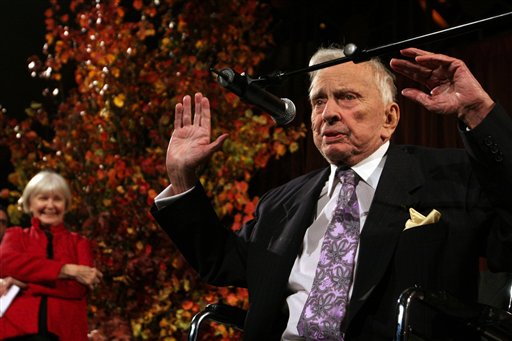
In a world more to his liking, Gore Vidal might have been president, or even king. He had an aristocrat's bearing — tall, handsome and composed — and an authoritative baritone ideal for summoning an aide or courtier.
But Vidal made his living — a very good living — from challenging power, not holding it. He was wealthy and famous and committed to exposing a system often led by men he knew firsthand. During the days of Franklin Roosevelt, one of the few leaders whom Vidal admired, he might have been called a "traitor to his class." The real traitors, Vidal would respond, were the upholders of his class.
The author, playwright, politician and commentator whose vast and sharpened range of published works and public remarks were stamped by his immodest wit and unconventional wisdom, died Tuesday at age 86 in Los Angeles.
Vidal died at his home in the Hollywood Hills at about 6:45 p.m. of complications from pneumonia, his nephew Burr Steers said. Vidal had been living alone in the home and had been sick for "quite a while," Steers said.
Vidal "meant everything to me when I was learning how to write and learning how to read," Dave Eggers said at the 2009 National Book Awards ceremony, where he and Vidal received honorary citations. "His words, his intellect, his activism, his ability and willingness to always speak up and hold his government accountable, especially, has been so inspiring to me I can't articulate it."
Along with such contemporaries as Norman Mailer and Truman Capote, he was among the last generation of literary writers who were also genuine celebrities — regulars on talk shows and in gossip columns, personalities of such size and appeal that even those who hadn't read their books knew their names.
His works included hundreds of essays, the best-selling novels "Lincoln" and "Myra Breckenridge" and the Tony-nominated play "The Best Man," a melodrama about a presidential convention revived on Broadway in 2012. Vidal appeared cold and cynical on the surface, dispassionately predicting the fall of democracy, the American empire's decline or the destruction of the environment. But he bore a melancholy regard for lost worlds, for reason and the primacy of the written word, for "the ancient American sense that whatever is wrong with human society can be put right by human action."
Vidal was uncomfortable with the literary and political establishment, and the feeling was mutual. Beyond his honorary National Book Award, he won few major writing prizes, lost both times he ran for office and initially declined membership into the American Academy of Arts and Letters, joking that he already belonged to the Diners Club. (He was eventually admitted, in 1999).
But he was widely admired as an independent thinker — in the tradition of Mark Twain and H.L. Mencken — about literature, culture, politics and, as he liked to call it, "the birds and the bees." He picked apart politicians, living and dead; mocked religion and prudery; opposed wars from Vietnam to Iraq and insulted his peers like no other, once observing that the three saddest words in the English language were "Joyce Carol Oates." (The happiest words: "I told you so").
Ralph Ellison labeled him a "campy patrician." Vidal had an old-fashioned belief in honor, but a modern will to live as he pleased. He wrote in the memoir "Palimpsest" that he had more than 1,000 "sexual encounters," nothing special, he added, compared to the pursuits of such peers as John F. Kennedy and Tennessee Williams. Vidal was fond of drink and alleged that he had sampled every major drug, once. He never married and for decades shared a scenic villa in Ravello, Italy, with companion Howard Austen.
In print and in person, he was a shameless name dropper, but what names! John and Jacqueline Kennedy. Hillary Clinton. Tennessee Williams. Mick Jagger. Orson Welles. Frank Sinatra. Marlon Brando. Paul Newman and Joanne Woodward. Tim Robbins and Susan Sarandon.
Vidal dined with Welles in Los Angeles, lunched with the Kennedys in Florida, clowned with the Newmans in Connecticut, drove wildly around Rome with a nearsighted Williams and escorted Jagger on a sightseeing tour along the Italian coast. He campaigned with Eleanor Roosevelt and Harry Truman. He butted heads, literally, with Mailer. He helped director William Wyler with the script for "Ben-Hur." He made guest appearances on everything from "The Simpsons" to "Rowan and Martin's Laugh-In."
Vidal formed his most unusual bond with Oklahoma City bomber Timothy McVeigh. The two exchanged letters after Vidal's 1998 article in Vanity Fair on "the shredding" of the Bill of Rights and their friendship inspired Edmund White's play "Terre Haute."
"He's very intelligent. He's not insane," Vidal said of McVeigh in a 2001 interview.
Vidal also bewildered his fans by saying the Bush administration likely had advance knowledge of the Sept. 11, 2001 attacks; that McVeigh was no more a killer than Dwight Eisenhower and that the U.S. would eventually be subservient to China, "The Yellow Man's Burden."
Christopher Hitchens, who once regarded Vidal as a modern Oscar Wilde, lamented in a 2010 Vanity Fair essay that Vidal's recent comments suffered from an "utter want of any grace or generosity, as well as the entire absence of any wit or profundity." Years earlier, Saul Bellow stated that "a dune of salt has grown up to season the preposterous things Gore says."
A longtime critic of American militarism, Vidal was, ironically, born at the United States Military Academy in West Point, N.Y., his father's alma mater. Vidal grew up in a political family. His grandfather, Thomas Pryor Gore, was a U.S. senator from Oklahoma. His father, Gene Vidal, served briefly in President Franklin Roosevelt's administration and was an early expert on aviation. Amelia Earhart was a family friend and reported lover of Gene Vidal.
Vidal was a learned, but primarily self-educated man. Classrooms bored him. He graduated from the elite Phillips Exeter Academy, but then enlisted in the Army and never went to college. His first book, the war novel "Williwaw," was written while he was in the service and published when he was just 20.
The New York Times' Orville Prescott praised Vidal as a "canny observer" and "Williwaw" as a "good start toward more substantial accomplishments." But "The City and the Pillar," his third book, apparently changed Prescott's mind. Published in 1948, the novel's straightforward story about two male lovers was virtually unheard of at the time and Vidal claimed that Prescott swore he would never review his books again. (The critic relented in 1964, calling Vidal's "Julian" a novel "disgusting enough to sicken many of his readers"). "City and the Pillar" was dedicated to "J.T.," Jimmie Trimble, a boarding school classmate killed during the war whom Vidal would cite as the great love of his life.
Unable to make a living from fiction, at least when identified as "Gore Vidal," he wrote a trio of mystery novels in the 1950s under the pen name "Edgar Box" and also wrote fiction as "Katherine Everard" and "Cameron Kay." He became a playwright, too, writing for the theater and television. "The Best Man," which premiered in 1960, was made into a movie starring Henry Fonda. Paul Newman starred in "The Left-Handed Gun," a film adaptation of Vidal's "The Death of Billy the Kid."
Vidal also worked in Hollywood, writing the script for "Suddenly Last Summer" and adding a subtle homoerotic context to "Ben-Hur." The author himself later appeared in a documentary about gays in Hollywood, "The Celluloid Closet." His acting credits included "Gattaca," ''With Honors" and Tim Robbins' political satire, "Bob Roberts."
But Vidal saw himself foremost as a man of letters. He wrote a series of acclaimed and provocative historical novels, including "Julian," ''Burr" and "Lincoln." His 1974 essay on Italo Calvino in The New York Review of Books helped introduce the Italian writer to American audiences. A 1987 essay on Dawn Powell helped restore the then-forgotten author's reputation and bring her books back in print. Fans welcomed his polished, conversational essays or his annual "State of the Union" reports for the liberal weekly "The Nation."
He adored the wisdom of Montaigne, the imagination of Calvino, the erudition and insight of Henry James and Edith Wharton. He detested Thomas Pynchon, John Barth and other authors of "teachers' novels." He once likened Mailer's views on women to those of Charles Manson's. (From this the head-butting incident ensued, backstage at "The Dick Cavett Show.") He derided Buckley, on television, as a "crypto Nazi." He was accused of anti-Semitism after labeling conservative Norman Podhoretz a member of "the Israeli fifth column." He labeled Ronald Reagan "The Acting President" and identified Reagan's wife, Nancy, as a social climber "born with a silver ladder in her hand."
In the 1960s, Vidal increased his involvement in politics. In 1960, he was the Democratic candidate for Congress in an upstate New York district, but was defeated despite Ms. Roosevelt's active support and a campaign appearance by Truman. (In 1982, Vidal came in second in the California Democratic senatorial primary). In consolation, he noted that he did receive more votes in his district in 1960 than did the man at the top of the Democratic ticket, John F. Kennedy.
Thanks to his friendship with Jacqueline Kennedy, with whom he shared a stepfather, Hugh Auchincloss, he became a supporter and associate of President Kennedy, and wrote a newspaper profile on him soon after his election. With tragic foresight, Vidal called the job of the presidency "literally killing" and worried that "Kennedy may very well not survive."
Before long, however, he and the Kennedys were estranged, touched off by a personal feud between Vidal and Robert Kennedy apparently sparked by a few too many drinks at a White House party. By 1967, the author was an open critic, portraying the Kennedys as cold and manipulative in the essay "The Holy Family." Vidal's politics moved ever to the left and he eventually disdained both major parties as "property" parties — even as he couldn't help noting that Hillary Clinton had visited him in Ravello.
Meanwhile, he was again writing fiction. In 1968, he published his most inventive novel, "Myra Breckenridge," a comic best seller about a transsexual movie star. The year before, with "Washington, D.C.," Vidal began the cycle of historical works that peaked in 1984 with "Lincoln."
The novel was not universally praised, with some scholars objecting to Vidal's unawed portrayal of the president. The author defended his research, including suggestions that the president had syphilis, and called his critics "scholar-squirrels," more interested in academic status than in serious history.
But "Lincoln" stands as his most notable work of historical fiction, vetted and admired by a leading Lincoln biographer, David Herbert Donald, and even cited by the conservative Newt Gingrich as a favorite book. Gingrich's praise was contrasted by fellow conservative Rep. Michele Bachmann, who alleged she was so put off by Vidal's "Burr" that she switched party affiliation from Democrat to Republican.
In recent years, Vidal wrote the novel "The Smithsonian Institution" and the nonfiction best sellers "Perpetual War For Perpetual Peace" and "Dreaming War: Blood for Oil and the Cheney-Bush Junta." A second memoir, "Point to Point Navigation," came out in 2006. In 2009, "Gore Vidal: Snapshots in History's Glare" featured pictures of Vidal with Newman, Jagger, Johnny Carson, Jack Nicholson and Bruce Springsteen.
Vidal and Austen chose cemetery plots in Washington, D.C., between Jimmie Trimble and one of Vidal's literary heroes, Henry Adams. But age and illness did not bring Vidal closer to God. Wheelchair-bound in his 80s and saddened by the death of Austen and many peers and close friends, the author still looked to no existence beyond this one.
"Because there is no cosmic point to the life that each of us perceives on this distant bit of dust at galaxy's edge," he once wrote, "all the more reason for us to maintain in proper balance what we have here. "Because there is nothing else. No thing. This is it. And quite enough, all in all."
Vidal is survived by his half-sister Nina Straight and half brother Tommy Auchincloss.
Mary Louise Rasmuson, Who Led Women’s Army Corps, Dies at 101
She was not on the list.
Mary Louise Rasmuson, a leading figure in Alaskan
philanthropy and a champion of women's rights and education, has died at the
age of 101, the Rasmuson Foundation announced on Tuesday.
With her late husband Elmer, Rasmuson was co-leader of the
foundation that bore their name for over forty-five years and helped direct
more than $200 million in grants to Alaska nonprofits. She was, as well,
influential in setting the public and civic agenda for Anchorage and Alaska,
and her vision led to the creation of the Anchorage Museum of Art and History
in 1968. Rasmuson also served on the boards and in other capacities at many
nonprofits, including the American Cancer Society, the Anchorage March of
Dimes, the American Association of University Women, Alaska Native Sisterhood,
and Veterans of Foreign Wars, and was a lifetime member of the Association of
the U.S. Army and the National Association for the Advancement of Colored
People.
Earlier in her life, Rasmuson served as director of the
Women's Army Auxiliary Corps during World War II and is credited with a number
of achievements while in that position, including working with Congress to
increase service credit and benefits for women, integrating black women into
the corps, and expanding the range of military opportunities open to all women.
Her twenty years of military service were recognized with a Legion of Merit
award, the Women's Army Auxiliary Corps Service Medal, the American Campaign
Medal, the World War II Victory Medal, the Occupation Medal, and the National
Defense Medal. "When you hear about women seizing new opportunities to serve,"
said former U.S. Secretary of Defense William Perry, "remember that they
march behind Colonel Rasmuson."
Rasmuson aspired to higher education at a time when many
leading universities did not admit women. She attended Margaret Morrison
Carnegie College, the women's college at Carnegie Mellon University in
Pittsburgh, was one of the first two women awarded an honorary doctor of laws
degree from the Carnegie Institute of Technology, and received a meritorious
service award from the University of Alaska Anchorage.
Mrs. Rasmuson maintained an active voice in the affairs of
the Rasmuson Foundation and regularly attended board meetings into her late
nineties, when she transitioned to an emeritus position. Even in the last years
of her life, she received briefings on projects seeking foundation support.
"Just two weeks ago, Mary Louise met with the new University of Alaska
Anchorage Rasmuson Chair in Economics, and with a group of women veterans who
are starting a social service organization," said Diane Kaplan, the
foundation's president. "She offered sage advice and support to
both."
"We are fortunate to have had Mary Louise in our
family," said her stepson Ed Rasmuson, chair of the Rasmuson Foundation.
"We are also fortunate that she loved Alaska."
Born in East Pittsburgh, Pennsylvania, Milligan graduated
with a bachelor's in education from what is now Carnegie Mellon University and
received her masters in school administration from University of Pittsburgh.
She was one of the first two women who were awarded an honorary doctor of laws
degree from Carnegie Mellon. Prior to enlisting in the military, she worked as
a secretary, teacher, and assistant principal.
She enlisted in the United States Army during World War II,
where she started as a private in an experiment using women as military
professionals.
Lt. Col. Mary Louise Milligan receives the Legion of Merit
from Maj. Gen. Willard S. Paul, Director of Personnel and Administration, 1946.
She worked up the ranks, and in 1957, President Dwight
Eisenhower appointed Milligan director of the Women's Army Corps and in 1961,
President John F. Kennedy reappointed her.
Bill Doss, founding member of Athens band the Olivia Tremor
Control, died Monday.
Athens-Clarke County coroner Sonny Wilson confirmed that
Doss, of 255 Best Drive in Athens, Georgia, passed away, but could offer no
further details as an investigation is ongoing.
No evidence of foul play or suicide is evident and Doss had
no history of medical problems, Wilson said.
An autopsy was performed Tuesday at the Georgia Bureau of
Investigation State Crime Lab in Atlanta, but no immediate results were
avaialble.
"It's going to be one of those cases that could take
three to four months with all the tests they have to run," Wilson said.
Vague reports of Doss' death circled through social media
Monday and Tuesday. The band's Web site confirmed Doss' passing with the
statement: "We are devastated by the loss of our brother Bill Doss. We are
at a loss for words."
Doss was the co-founder of the Olivia Tremor Control along
with Will Hart and Jeff Mangum. They started the band in Louisiana before
relocating to Athens in the early 1990s. Doss was also a prominent member of
the Elephant 6 recording company, a collective of bands sharing a love of
psychedelic and classic pop sounds.
After releasing widely acclaimed records "Dusk at
Cubist Castle" and "Black Foliage," the band broke up in 2000,
with Doss forming new band Sunshine Fix. The Olivia Tremor Control reformed
temporarily in 2005 for the All Tomorrow's Parties festival, and started
recording and playing more frequently in recent years. Just last week, the band
played Team Clermont's Summer Showcase at the Georgia Theatre.
According to a Bill Doss wikipedia page, the musician was 43
years old at the time of his death. He is survived by his wife, Amy Hairston
Doss.
"Bill was incredibly inspiring to me through his music
and friendship," said Andrew Rieger of Elf Power, an Athens-based Elephant
6 affiliated band.
"He wrote so many great songs," Rieger said.
"'Jumping Fences' is in my opinion one of the greatest pop songs of all
time."
John Fernandes grew up with Doss in Louisiana and played in
Olivia Tremor Control.
He was an incredible songwriter and teacher," said
Fernandes.
"When he asked me to join (the band) in (1993), he
taught me how to play bass. He was the most beautiful spirit."
Fernandes said that Doss was excited about recording and
performing again with his old band.
"It's just such a shock," Fernandes said of
his friend's death. "It's such a tragedy."
WAGES, David (89) Passed away Monday, July 30th. He was a
former film editor for motion pictures and television for over 49 years, having
started in the Editorial Dept. at R.K.O. Studios and working at Warner
Brothers, Universal, M.G.M. and Paramount studios. He is survived by his wife
of 64 years, Janet Wages and son, William C. Wages. Graveside services will be
held 10 a.m. Fri., August 3, 2012 at Holy Cross Cemetery. Gates, Kingsley Gates
Culver City
Editor
Richard Dean Anderson in MacGyver (1985)
MacGyver
7.6
TV Series
Editor
1985–1986
8 episodes
Jamie Rose in Lady Blue (1985)
Lady Blue
6.5
TV Series
Editor
1985
2 episodes
Street Hawk (1985)
Street Hawk
6.7
TV Series
film editor
1985
1 episode
Tony Lo Bianco and Lindsay Wagner in Jessie (1984)
Jessie
7.5
TV Series
Editor
1984
2 episodes
George Washington (1984)
George Washington
7.8
TV Mini Series
Editor
1984
3 episodes
Patrick Duffy in Cry for the Strangers (1982)
Cry for the Strangers
4.7
TV Movie
Editor
1982
River Phoenix, Richard Dean Anderson, Peter Horton, Drake
Hogestyn, Terri Treas, and Roger Wilson in Seven Brides for Seven Brothers
(1982)
Seven Brides for Seven Brothers
6.6
TV Series
Editor
1982
1 episode
Today's F.B.I. (1981)
Today's F.B.I.
7.0
TV Series
Editor
1981
1 episode
Beulah Land (1980)
Beulah Land
6.6
TV Mini Series
Editor
1980
1 episode
Joe Don Baker in Eischied (1979)
Eischied
7.5
TV Series
Editor
1980
1 episode
Ricardo Montalban and Hervé Villechaize in Fantasy Island
(1977)
Fantasy Island
6.6
TV Series
film editor
1978–1979
11 episodes
The Courage and the Passion (1978)
The Courage and the Passion
6.5
TV Movie
Editor
1978
Doctors' Private Lives (1978)
Doctors' Private Lives
5.7
TV Movie
Editor
1978
Robert Forster, David Birney, and Richard E. Kalk in Police
Story (1973)
Police Story
7.5
TV Series
Editor
1973–1978
33 episodes
Roger & Harry: The Mitera Target
5.8
TV Movie
Editor
1977
Banjo Hackett: Roamin' Free (1976)
Banjo Hackett: Roamin' Free
6.3
TV Movie
Editor
1976
A Matter of Wife... and Death (1975)
A Matter of Wife... and Death
6.0
TV Movie
Editor
1975
Robert Forster in Nakia (1974)
Nakia
7.3
TV Series
Editor
1974
1 episode
Glenn Ford and Yvonne Craig in Jarrett (1973)
Jarrett
5.8
TV Movie
Editor
1973
Circle of Fear (1972)
Circle of Fear
7.6
TV Series
film editor
1972–1973
7 episodes
Michael J. Pollard in Dirty Little Billy (1972)
Dirty Little Billy
6.2
Editor
1972
Barbara Bain, Martin Landau, Peter Graves, Peter Lupus, and
Greg Morris in Mission: Impossible (1966)
Mission: Impossible
7.9
TV Series
film editor
1967–1971
28 episodes
Christopher George in The Immortal (1969)
The Immortal
7.5
TV Series
Editor
1969
1 episode
Barbara Bain, Martin Landau, Peter Graves, and Greg Morris
in Mission Impossible Versus the Mob (1969)
Mission Impossible Versus the Mob
6.8
Editor
1969
F Troop (1965)
F Troop
7.4
TV Series
Editor
1966–1967
22 episodes
Oh Dad, Poor Dad, Mamma's Hung You in the Closet and I'm
Feelin' So Sad (1967)
Oh Dad, Poor Dad, Mamma's Hung You in the Closet and I'm
Feelin' So Sad
4.8
Editor
1967
Patrick O'Neal in Chamber of Horrors (1966)
Chamber of Horrors
6.0
Editor
1966
Stella Stevens, Richard Conte, Chuck Connors, Alex Cord,
Eartha Kitt, and Edmond O'Brien in Get Off My Back (1965)
Get Off My Back
5.9
Editor
1965
Jack Lemmon, Virna Lisi, Eddie Mayehoff, Terry-Thomas, and
Claire Trevor in How to Murder Your Wife (1965)
How to Murder Your Wife
6.5
Editor
1965
Natalie Wood and Tony Curtis in Sex and the Single Girl
(1964)
Sex and the Single Girl
6.4
Editor
1964
Troy Donahue, Diane McBain, and Suzanne Pleshette in A
Distant Trumpet (1964)
A Distant Trumpet
6.3
Editor
1964
Mary, Mary (1963)
Mary, Mary
5.9
Editor
1963
Spencer's Mountain (1963)
Spencer's Mountain
7.0
Editor
1963
Edd Byrnes, Roger Smith, and Efrem Zimbalist Jr. in 77
Sunset Strip (1958)
77 Sunset Strip
7.7
TV Series
film editor
1958–1963
11 episodes
The Gallant Men (1962)
The Gallant Men
7.9
TV Series
Editor
1962
1 episode
Robert Conrad, Anthony Eisley, Poncie Ponce, and Connie
Stevens in Hawaiian Eye (1959)
Hawaiian Eye
7.6
TV Series
film editor
1959–1962
5 episodes
Surfside 6 (1960)
Surfside 6
7.9
TV Series
film editor
1960–1961
7 episodes
Donald May, Dorothy Provine, and Rex Reason in The Roaring
20's (1960)
The Roaring 20's
8.0
TV Series
Editor
1960–1961
4 episodes
James Garner and Jack Kelly in Maverick (1957)
Maverick
8.0
TV Series
Editor
1959–1961
4 episodes
Sugarfoot (1957)
Sugarfoot
7.4
TV Series
Editor
1959–1960
3 episodes
Andrew Duggan, Arlene Howell, Richard Long, and Van Williams
in Bourbon Street Beat (1959)
Bourbon Street Beat
7.8
TV Series
Editor
1960
1 episode
Roger Moore in The Alaskans (1959)
The Alaskans
8.1
TV Series
film editor
1959–1960
4 episodes
Lawman (1958)
Lawman
8.1
TV Series
Editor
1958–1960
6 episodes
Pamela Duncan and Donald May in Colt .45 (1957)
Colt .45
7.1
TV Series
film editor
1959
1 episode
Ty Hardin in Bronco (1958)
Bronco
7.1
TV Series
Editor
1958–1959
2 episodes
Anne Neyland and John Payne in Hidden Fear (1957)
Hidden Fear
5.4
Editor
1957
Editorial Department
John Forsythe, Jane Darwell, Edgar Buchanan, Gladys George,
Frank McHugh, and Loretta Young in It Happens Every Thursday (1953)
New Zealand film and television star Jonathan Hardy has died
at the age of 71, it has been reported.
Best known for his role on cult sci-fi show Farscape, Hardy
was honoured by his co-star Lani Tupu on Facebook, Examiner.com reported.
Bushy-browed, New Zealand-born actor and writer Jonathan
Hardy became most familiar to television audiences as the commanding voice of
the Jim Henson Creature Shop muppet, Dominar Rygel XVI, the pint-sized ,
egocentric ruler-in-exile of a galactic empire, in TV's cult series Farscape
(1999). His distinctive diction proved ideally suited to lending both humour
and personality to the cantankerous, idiosyncratic 26-inch Hynerian.
Jonathan was educated at St. Patrick's College and Victoria
University in Wellington, and trained for acting at the New Zealand Player's
Drama School. In later years, he became a force in his country's theatrical
scene as artistic director of the Auckland Mercury Theatre, from 1980 to 1985.
Prior to that, he had studied at the London Academy of Music and Dramatic Art
on a scholarship, and subsequently spent ten years gaining valuable experience
on British stages -- with the National Theatre, the Bristol Old Vic and with
the Royal Shakespeare Company in Stratford-upon Avon. Back in the antipodes, he
was especially acclaimed for his performance as Willy Loman in an Auckland
Theatre Company production of "Death of a Salesman". With the same
organisation, he had another winning role in "Twelve Angry Men".
After moving to Australia in 1972, Jonathan was notably featured in the films
The Mango Tree (1977) and Mad Max (1979), and had guest spots on popular
television shows like Prisoner (1979) and The Flying Doctors (1986). He also
made occasional forays into screenwriting. His first, for the controversial
Boer war drama Breaker Morant (1980), won him an Oscar nomination (along with
Bruce Beresford and David Stevens), and an Australian Film Institute Award. In
the cast of the two-act play "Breaker Morant", debuting at the
Athenaeum Theatre in Melbourne (February 1978), he played the key role of Major
James Francis Thomas, who defended Morant at the infamous court martial.
Jonathan was known in his profession for his work ethic and
boundless energy. In fact, he soldiered on for many years after 1988, despite
having undergone the trauma of heart transplant surgery. He also had a
reputation for a wonderfully wicked sense of humour ...after all, he once
described Rygel's most endearing traits on "Farscape" to be
"biting people and farting helium"!
Director
Laura Branigan in Backstage (1988)
Backstage
7.1
Director
1988
Writer
Wishbone
Writer
2006
The Adventures of Skippy (1992)
The Adventures of Skippy
6.7
TV Series
Writer
1992
1 episode
Porters
TV Series
Writer (as Jonathon Hardy)
1988
1 episode
Laura Branigan in Backstage (1988)
Backstage
7.1
screenplay
1988
Constance (1984)
Constance
5.7
screenplaystory
1984
Edward Woodward in Breaker Morant (1980)
Breaker Morant
7.8
screenplay by
1980
Actor
Magical Tales (2010)
Magical Tales
7.6
TV Series
Wally
2012
1 episode
Big in Japan
Short
Dr. Timpleton
2009
Wishbone
Homeless Man
2006
Hunt Angels poster
Hunt Angels
6.7
Magistrate
2006
Severance (2005)
Severance
7.5
Therapy Group
2005
Farscape: The Peacekeeper Wars (2004)
Farscape: The Peacekeeper Wars
8.2
TV Mini Series
Rygel XVI (voice)
2004
2 episodes
MDA (2002)
MDA
7.3
TV Series
Justice Tulloch
2003
2 episodes
Rebecca Gibney, Kate Kendall, Peter Phelps, and Gary Sweet
in Stingers (1998)
Stingers
7.1
TV Series
Stephen Betjeman
2003
1 episode
The Secret Life of Us (2001)
The Secret Life of Us
7.6
TV Series
Tribunal Man
2003
1 episode
Heath Ledger and Orlando Bloom in Ned Kelly (2003)
Ned Kelly
6.4
The Great Orlando
2003
Claudia Black, Ben Browder, and Virginia Hey in Farscape
(1999)
Farscape
8.3
TV Series
Dominar Rygel XVIKa D'ArgoRygel ...
1999–2003
86 episodes
Farscape: The Game (2002)
Farscape: The Game
7.5
Video Game
Rygel XVI (voice)
2002
Nicole Kidman and Ewan McGregor in Moulin Rouge! (2001)
Moulin Rouge!
7.6
Man In The Moon
2001
Camping with Camus
7.0
Short
Uncle Blick
2000
Above the Law (2000)
Above the Law
6.2
TV Series
Stan the Fingers
2000
1 episode
Bob Baines, Andrew Clarke, and Wendy Hughes in State Coroner
(1997)
State Coroner
6.8
TV Series
Steve Capelli
1998
1 episode
Jack Campbell, John Howard, Judith McGrath, Tammy Macintosh,
John Waters, Andrew Supanz, and Mirrah Foulkes in All Saints (1998)
All Saints
7.1
TV Series
Cliff Unwin
1998
1 episode
Terrain
6.7
TV Movie
Giles Ballard
1997
Down Rusty Down (1997)
Down Rusty Down
7.7
Short
Otis
1997
Dust Off the Wings (1997)
Dust Off the Wings
5.9
Celebrant (as Johnathon Hardy)
1997
Twisted Tales (1996)
Twisted Tales
7.1
TV Series
Roger Mormon
1997
1 episode
My Entire Life (1996)
My Entire Life
6.6
Reverend McIntyre
1996
Medivac (1996)
Medivac
8.0
TV Series
Rosenthal
1996
1 episode
Tayler Kane in Fire (1995)
Fire
7.4
TV Series
Sgt Steve (as Jonathon Hardy)
1996
1 episode
Snowy River: The McGregor Saga (1994)
Snowy River: The McGregor Saga
7.3
TV Series
John Archer Sr.
1996
1 episode
Richard Chamberlain and Amanda Donohoe in The Thorn Birds:
The Missing Years (1996)
The Thorn Birds: The Missing Years
6.2
TV Movie
Father Emilio
1996
Tunnel Vision (1995)
Tunnel Vision
4.3
TV Movie
Henry Adams
1995
Mission Top Secret (1993)
Mission Top Secret
8.1
TV Series
Bombalini
1995
1 episode
Michael Craig and Denise Roberts in G.P. (1989)
G.P.
7.2
TV Series
Robert Houghton (as Jonathon Hardy)
1995
1 episode
The Nostradamus Kid (1993)
The Nostradamus Kid
5.7
'General Booth Enters Heaven' Strolling Player
1993
The Adventures of Skippy (1992)
The Adventures of Skippy
6.7
TV Series
Grandad Bill
1992
2 episodes
A Country Practice (1981)
A Country Practice
6.8
TV Series
Patrick Gardiner
1990
1 episode
Winners (1985)
Winners
7.5
TV Series
Mr. Bretherton
1990
1 episode
The Flying Doctors (1986)
The Flying Doctors
6.8
TV Series
Tyler Wells
1990
1 episode
Bloodmoon (1990)
Bloodmoon
4.7
Mayor
1990
Abigail, Diane Craig, Anne Phelan, and Dinah Shearing in
Family and Friends (1990)
Family and Friends
TV Series
Brother Ignatius
1990
Kylie Minogue and Charlie Schlatter in The Delinquents
(1989)
The Delinquents
5.7
Magistrate
1989
E Street (1989)
E Street
6.6
TV Series
Liam Buckley
1989
3 episodes
Jane Badler, Peter Graves, Antony Hamilton, Terry Markwell,
Phil Morris, and Thaao Penghlis in Mission: Impossible (1988)
Mission: Impossible
7.5
TV Series
Etienne Reynard
1989
1 episode
John Wood in Rafferty's Rules (1987)
Rafferty's Rules
7.1
TV Series
Mr. Linnehan
1989
1 episode
Lie of the Land
6.0
Doctor Max Steiner
1985
Jodie Foster and John Lithgow in Mesmerized (1985)
Mesmerized
4.7
Burley
1985
Wills & Burke (1985)
Wills & Burke
4.3
John Macadam
1985
Death Warmed Up (1984)
Death Warmed Up
4.6
Ranji Gandhi
1984
Heroes (1984)
Heroes
8.7
TV Series
Shopkeeper
1984
2 episodes
Constance (1984)
Constance
5.7
Randolf Grieve
1984
Nearly No Christmas (1983)
Nearly No Christmas
2.6
TV Movie
Mr. Rich (as Jonathon Hardy)
1983
Lonely Hearts (1982)
Lonely Hearts
6.9
Bruce
1982
John Carradine in Klynham Summer (1982)
Klynham Summer
5.8
Charlie Dabney
1982
Maggie Kirkpatrick in Prisoner (1979)
Prisoner
8.1
TV Series
WallerMr. Potter
1980–1981
3 episodes
Under the Mountain (1981)
Under the Mountain
7.9
TV Series
Country Policeman (as Jonathon Hardy)
1981
1 episode
Twenty Good Years (1979)
Twenty Good Years
7.2
TV Series
Josef Goldman
1979
12 episodes
The John Sullivan Story (1979)
The John Sullivan Story
6.4
TV Movie
Vlad
1979
Mel Gibson in Mad Max (1979)
Mad Max
6.8
Labatouche (as Jonathon Hardy)
1979
Lorraine Bayly, Paul Cronin, Susan Hannaford, Andrew
McFarlane, Richard Morgan, and Steven Tandy in The Sullivans (1976)
The Sullivans
6.9
TV Series
Captain
1978
1 episode
Against the Wind (1978)
Against the Wind
8.1
TV Mini Series
Sam Fitchett
1978
1 episode
The Truckies (1978)
The Truckies
7.4
TV Series
1978
1 episode
The Mackenzie Affair (1977)
The Mackenzie Affair
TV Mini Series
Judge
1977
The Trial of Ned Kelly
8.3
TV Movie
1977
The Mango Tree (1977)
The Mango Tree
6.8
Joe Speight
1977
John Hargreaves in Young Ramsay (1977)
Young Ramsay
7.9
TV Series
Colonel Flynn
1977
1 episode
John Diedrich, Lucky Grills, and Gerda Nicolson in Bluey
(1976)
Bluey
7.6
TV Series
Benny Allman
1977
1 episode
Martin Vaughan in Power Without Glory (1976)
Power Without Glory
8.5
TV Mini Series
Paddy KelleherRev. Joggins
1976
3 episodes
Andra (1976)
Andra
7.9
TV Series
Shenlyn
1976
6 episodes
The Devil's Playground (1976)
The Devil's Playground
6.8
Brother Arnold
1976
Rush (1974)
Rush
8.3
TV Series
Yorkshire Goldminer
1974
1 episode
Moving On (1974)
Moving On
Anne's Boyfriend
1974
Redheap (1972)
Redheap
TV Series
Henry
1972
3 episodes
The Adventures of Barry McKenzie (1972)
The Adventures of Barry McKenzie
5.6
Groove Courtenay
1972
Mandog (1972)
Mandog
7.1
TV Series
Halmar
1972
5 episodes
Producer
Porters
TV Series
producer (as Jonathon Hardy)
1988
1 episode
Additional Crew
Claudia Black, Ben Browder, and Virginia Hey in Farscape
(1999)
Farscape
8.3
TV Series
puppetry
1999
1 episode
Tom Burlinson and Sigrid Thornton in Return to Snowy River
(1988)
Return to Snowy River
6.6
associate to the director
1988
Thanks
The ScapeCast (2006)
The ScapeCast
Podcast Series
thanks
2008
1 episode
Self
The ScapeCast (2006)
The ScapeCast
Podcast Series
Self
2007–2008
4 episodes
Claudia Black, Ben Browder, Gigi Edgley, and Raelee Hill in
Farscape Undressed (2001)
He worked in film and TV with John Cassavetes and Peter Falk, two of his buddies from New York.
John Finnegan, a character actor who appeared in five films for John Cassavetes and a dozen episodes of Columbo starring Peter Falk, died Sunday at his home in Palm Desert, Calif., from pneumonia and complications of old age, his wife told the Los Angeles Times. He was 85.
Finnegan also played a baseball scout in Robert Redford’s The Natural (1984) and voiced Warren T. Rat, a villain in the animated An American Tail (1986).
At the Actors Studio in his native New York, Finnegan became friends with Cassavetes and Falk, who helped him when he moved to Los Angeles in the early 1950s.
Finnegan had roles in Cassavetes’ A Woman Under the Influence (1974), The Killing of a Chinese Bookie (1976), Opening Night (1977), Gloria (1980) and Big Trouble (1986). Falk, a key member of Cassavetes’ independent acting troupe, was in Under the Influence and Big Trouble as well.
Finnegan played a variety of supporting parts in Columbo episodes and telefilms between 1972 and 2003 and had a bit part in the Falk comedy classic The In-Laws (1979).
Finnegan also appeared in such movies as Oliver Stone’s JFK (1991), Last Action Hero (2003) and Mars Attacks! (1996) and the TV series Banacek, Maude, Police Woman, McMillan & Wife, McCloud, 227 and ER.
Survivors include his wife, Carolynn.
Partial filmography
Play It as It Lays
(1972) - Frank
A Woman Under the
Influence (1974) - Clancy
Capone (1975) -
N.Y. Police Lt.
The Killing of a
Chinese Bookie (1976) - Taxi Driver
Nickelodeon (1976)
- Kathleen's Director
Heroes (1977) -
Mr. Munro
Opening Night
(1977) - Bobby
Bloodbrothers
(1978) - Bartender
The In-Laws (1979)
- Deliveryman #1
Little Miss Marker
(1980) - Casino Clerk
Gloria (1980) -
Frank
Love Streams
(1984) - Taxi Driver
The Natural (1984)
- Sam Simpson
The Journey of
Natty Gann (1985) - Logging Boss
School Spirit
(1985) - Pinky Batson
Big Trouble (1986)
- Det. Murphy
An American Tail
(1986) - Warren T. Rat (voice)
Spellbinder (1988)
- George (uncredited)
Big Man on Campus
(1989) - Judge Ferguson
The Last of the
Finest (1990) - Tommy Grogan
Come See the
Paradise (1990) - Brennan
JFK (1991) - Judge
Haggerty
Last Action Hero
(1993) - Watch Commander
Mars Attacks!
(1996) - Speaker of the House
Vegas Vacation
(1997) - Arty, the Hoover Dam Guide
.jpeg)


.jpg)